SVI3 Protocolos compatibles
AlimentaciónAMD Serial VID Interface 3
¿Qué es SVI3?
SVI3 (Serial VID Interface 3) is AMD's proprietary serial bus protocol for communication between AMD processors and voltage regulator modules (VRMs). SVI3 uses three signals — SVC (clock), SVD (data), and SVT (telemetry) — to manage dynamic voltage and frequency scaling. The protocol enables the processor to command voltage changes, read VRM telemetry (current, temperature), and manage power states. SVI3 operates at clock speeds up to 50 MHz with a voltage range of 1.08V to 1.98V, and includes features for fast transient response and power state management that are critical for AMD Ryzen and EPYC processor platforms. Acute decoders cover SVI3 Rev. 1.01 and Rev. 2.0. Engineers debugging AMD power delivery systems need SVI3 decode to verify voltage requests, telemetry accuracy, and VRM response timing.
SVI3 Referencia rápida
| type | Serial, synchronous |
| signals | SVC, SVD, SVT (3 wires) |
| max Speed | Up to 50 MHz |
| voltage Range | 1.08V – 1.98V |
| standard | AMD SVI3 Rev. 1.01, Rev. 2.0 |
Aviso importante
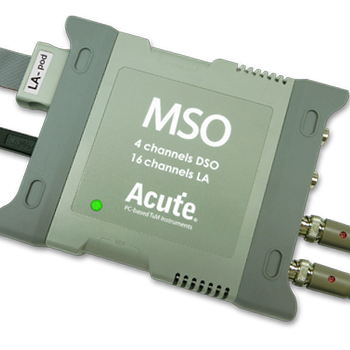
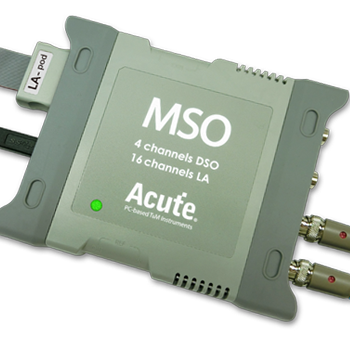
SVI3 protocol support is available only on the MSO2216B, MSO3124H, and MSO3124V. SVI3 decoding is provided to end customers upon request, and only to users who have been approved by AMD.
¿Listo para analizar este protocolo?
Vea cómo los instrumentos Acute capturan y decodifican este protocolo en tiempo real. Solicite una demo o contacte a nuestro equipo.
¿Cómo analizar SVI3 con instrumentos Acute
Conecte su analizador lógico Acute a las señales SVI3 SVC, SVD y SVT entre el procesador AMD y el regulador de voltaje.
Conecte un cable de tierra a la referencia de tierra de la placa objetivo.
En el software Acute, seleccione el SVI3 protocol decoder y asigne SVC, SVD y SVT a los canales de entrada correspondientes.
Configure el decodificador para expected bus speed and protocol versión.
Capture y visualice los SVI3 transactions showing voltage ID commands, telemetry readbacks, and power state transitions.