GMII Protocol Support
Computers & ServersGigabit Media Independent Interface
What is GMII?
GMII (Gigabit Media Independent Interface) is the original 8-bit-wide parallel interface for Gigabit Ethernet MAC-to-PHY connections, defined in IEEE 802.3z. GMII uses separate 8-bit transmit and receive data buses clocked at 125 MHz, providing 1 Gbps throughput without requiring DDR signaling. While RGMII has largely replaced GMII in new designs due to its lower pin count, GMII is still found in FPGA-based Ethernet implementations, network equipment, and legacy designs where the wider bus and simpler SDR timing are advantageous. Engineers working with GMII need to verify data bus timing, clock relationships, and frame integrity at the MAC-PHY boundary.
GMII Quick Reference
| type | Parallel |
| signals | TXD[7:0], RXD[7:0], GTX_CLK, RX_CLK, etc. |
| max Speed | 125 MHz (1 Gbps) |
| voltage Range | 2.5V |
| standard | IEEE 802.3z |
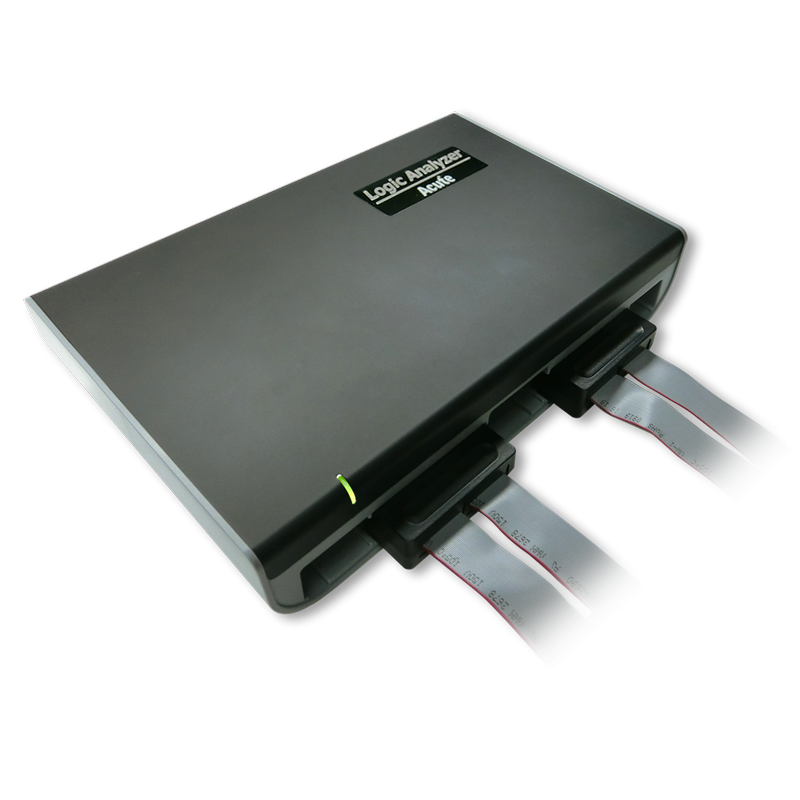
Acute Instruments Supporting GMII

Ready to analyze this protocol?
See how Acute instruments capture and decode this protocol in real time. Request a demo or contact our team.
How to Analyze GMII with Acute Instruments
Connect your Acute logic analyzer to the GMII signals: TXD[7:0], GTX_CLK, TX_EN, TX_ER, RXD[7:0], RX_CLK, RX_DV, and RX_ER.
Attach a ground lead to the target board's ground reference.
In the Acute software, select the GMII protocol decoder and assign each signal to the correct input channel.
Configure the expected Ethernet speed (10, 100, or 1000 Mbps).
Capture and view decoded Ethernet frames for both directions, verifying payload integrity and FCS validation.