MII Protocol Support
Computers & ServersMedia Independent Interface
What is MII?
MII (Media Independent Interface) is the standard parallel interface between an Ethernet MAC controller and a PHY transceiver for 10/100 Mbps Ethernet. Defined in IEEE 802.3u, MII uses separate 4-bit-wide transmit and receive data paths, each with its own clock, plus control signals for carrier sense, collision detection, and data valid indication. MII operates at 2.5 MHz for 10 Mbps Ethernet and 25 MHz for 100 Mbps. Engineers debugging Ethernet connectivity at the hardware level use MII analysis to verify data framing, clock timing, and MAC-PHY communication during link establishment and packet transfer.
MII Quick Reference
| type | Parallel |
| signals | TXD[3:0], RXD[3:0], TX_CLK, RX_CLK, etc. |
| max Speed | 25 MHz (100 Mbps) |
| voltage Range | 3.3V |
| standard | IEEE 802.3u |
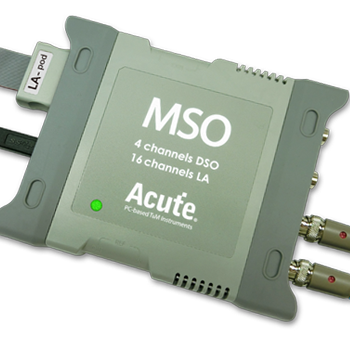

Ready to analyze this protocol?
See how Acute instruments capture and decode this protocol in real time. Request a demo or contact our team.
How to Analyze MII with Acute Instruments
Connect your Acute logic analyzer to the MII signals: TXD[3:0], RXD[3:0], TX_CLK, RX_CLK, TX_EN, RX_DV, and optionally CRS and COL.
Attach a ground lead to the target board's ground reference.
In the Acute software, select the MII protocol decoder and assign each signal to the correct input channel.
Configure the expected Ethernet speed (10 Mbps or 100 Mbps).
Capture and view decoded Ethernet frames showing preamble, MAC addresses, EtherType, payload, and FCS for both transmit and receive directions.