Power Sequence Protocol Support
PowerPower Sequence Validation (16–128 channels)
What is Power Sequence?
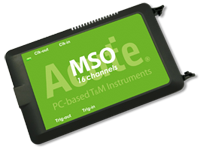
Power Sequence Validation is a multi-channel digital capture capability designed to verify the timing and order of power rail enable signals and power-good (PG) outputs during system power-up and power-down. Modern electronic systems have dozens of power rails that must ramp in a specific order with precise timing relationships — incorrect sequencing can cause latch-up, component damage, or silent initialization failures. **The MSO2216B is Acute's recommended instrument for power sequence validation**, providing 16 channels per unit with multi-unit cascading: cascade 2 MSO2216B for 32 channels, scaling up to 128 channels for the most complex server, notebook, and SoC platforms. The software supports CSV-driven configuration (load parameter files defining channel names, voltage thresholds, and timing rules) and produces HTML and CSV compliance reports with automated waveform rendering. Common applications include PCs, notebooks, servers, cloud systems, and MCU platforms in smartphones, tablets, automotive, and consumer electronics. Engineers use this capability during hardware bring-up, compliance testing, and failure analysis to verify that the actual power sequencing matches the design specification.
Power Sequence Quick Reference
| type | Multi-channel digital capture |
| signals | Power rail enable/PG signals |
| channels | 16–128 channels |
| features | Multi-rail timing validation |
Acute Instruments Supporting Power Sequence
Recommended Solutions
All Supporting Products
MSO2000 Series
Supported Product Families
Ready to analyze this protocol?
See how Acute instruments capture and decode this protocol in real time. Request a demo or contact our team.
How to Analyze Power Sequence with Acute Instruments
Connect your Acute logic analyzer channels to the enable and power-good signals of each power rail on the target board.
Attach a ground lead to the target board's ground reference.
In the Acute software, configure the power sequence validation mode and assign channels to each monitored rail.
Set trigger conditions for the initial power-on event (e.g., main power switch or system enable signal).
Capture the full power-up sequence and use the timing measurement tools to verify rail-to-rail sequencing order, ramp timing, and power-good assertion delays against your design specification.