NAND Flash Protocol Support

Storage

Parallel NAND Flash Interface

What is NAND Flash?

Parallel NAND Flash is the raw interface used to communicate with NAND flash memory devices, providing direct access to the flash command set for read, program, erase, and status operations. The interface uses an 8-bit bidirectional data bus (IO[7:0]) along with control signals including CLE (Command Latch Enable), ALE (Address Latch Enable), WE# (Write Enable), RE# (Read Enable), and CE# (Chip Enable). Modern NAND flash devices conforming to ONFI 4.0 can operate at up to 200 MHz with DDR signaling. Engineers debugging embedded storage systems, SSD controllers, and NAND-based designs need parallel NAND analysis to verify command sequences, timing parameters, and data integrity at the flash interface level.

NAND Flash Quick Reference

type Parallel
signals IO[7:0], CLE, ALE, WE, RE, CE
max Speed 200 MHz (ONFI 4.0)
voltage Range 1.8V / 3.3V
features Raw NAND interface

Acute Instruments Supporting NAND Flash

Recommended Solutions

Recommended for Decode

TL4234B

TL4234B

All Supporting Products

Protocol Decode
Hardware Trigger
Protocol Exerciser

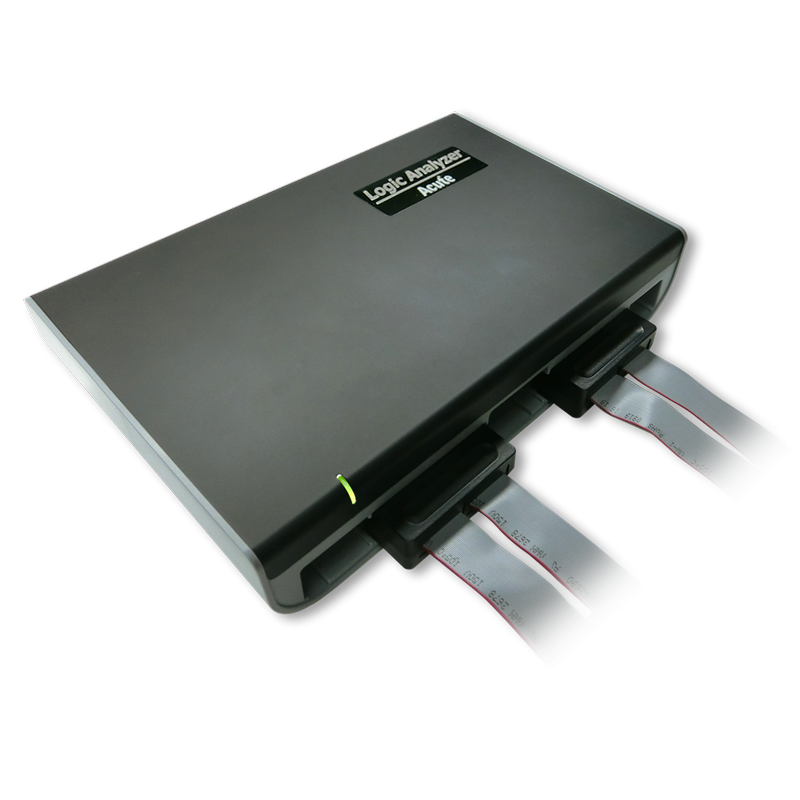
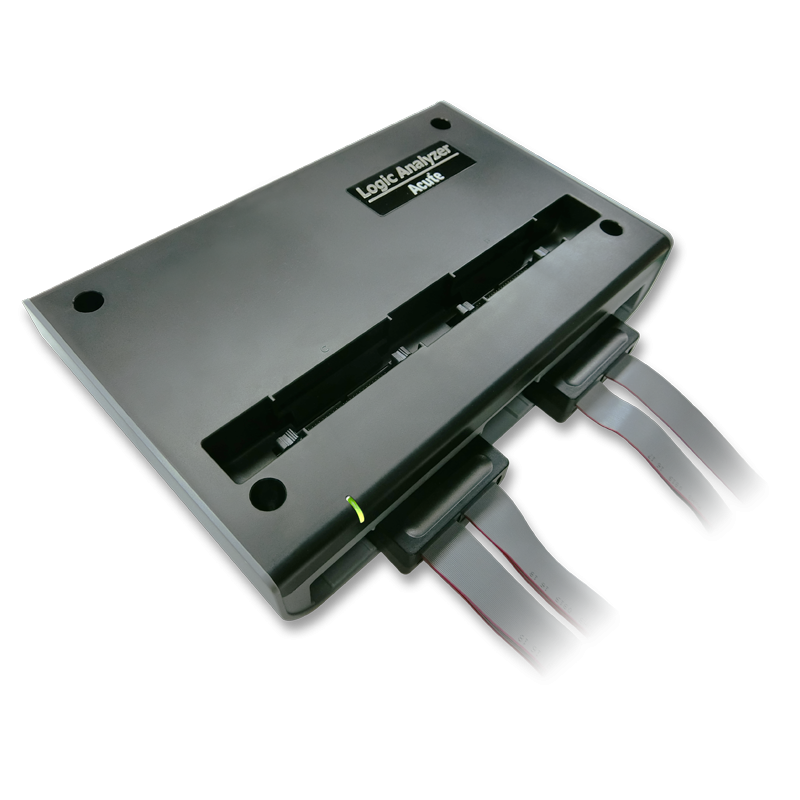
LA4000 Series

MSO3000 Series

TravelLogic Series

Ready to analyze this protocol?

See how Acute instruments capture and decode this protocol in real time. Request a demo or contact our team.

How to Analyze NAND Flash with Acute Instruments

1

Connect your Acute logic analyzer to the NAND flash signals: IO[7:0], CLE, ALE, WE#, RE#, CE#, and optionally R/B# (Ready/Busy).

2

Attach a ground lead to the target board's ground reference.

3

In the Acute software, select the NAND Flash protocol decoder and assign each signal to the correct input channel.

4

Configure the decoder for the NAND device type, addressing mode, and interface speed.

5

Capture and view decoded NAND commands, addresses, and data showing read, program, erase operations, and status responses.

Frequently Asked Questions

What sample rate do I need for NAND flash analysis?
For ONFI SDR (asynchronous) NAND at timing modes up to 50 MHz, sample at 200 MHz or higher. For ONFI DDR (synchronous) at 100-200 MHz, where data transitions on both clock edges, sample at 500 MHz to 1 GHz. Acute instruments with 2 GHz timing analysis can capture the fastest ONFI 4.0 interfaces. Lower-speed NAND devices in legacy designs require proportionally lower sample rates.
Why is my NAND flash controller failing to read data correctly?
NAND read failures commonly result from incorrect command sequences (missing address cycles), timing violations on WE#/RE# pulse widths, or insufficient wait time for the Ready/Busy signal before reading data. Capture the full read command sequence and verify each step against the NAND datasheet. Check that the number of address cycles matches the device capacity and that the controller waits for the R/B# signal to go high before asserting RE# for data read-out.
How many channels are needed for NAND flash analysis?
A standard 8-bit NAND interface requires 14-15 channels: IO[7:0] (8), CLE, ALE, WE#, RE#, CE# (5), and optionally R/B# (1) and WP# (1). For 16-bit NAND (IO[15:0]), add 8 more data channels. The BusFinder dedicated protocol analyzer and the LA4000 series provide the channel count and timing resolution needed for NAND analysis.

Related Protocols

Need help choosing the right instrument for your protocol? Contact our engineering team.